‘Open justice went completely out the window’: Why the US government must pardon Julian Assange
After interviewing three international journalists who covered Julian Assange’s extradition trial in London, I wrote an opinion piece for class about the most urgent issue in journalism.
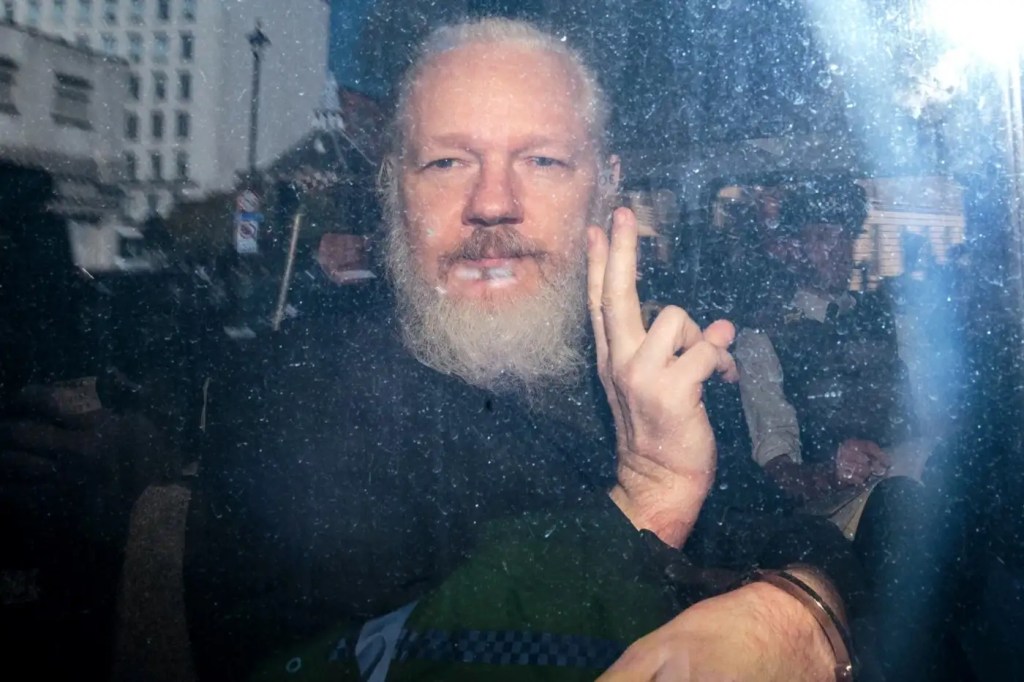
Julian Assange, founder of WikiLeaks, awaits a January 4 extradition ruling; until then, we must demand his pardon or face a crushing blow to journalism.
“This is the most important case concerning press freedom in our lifetime,” said Juan Passarelli, investigative journalist and filmmaker and director of the documentary titled “The War on Journalism: The Case of Julian Assange.” “There’s nothing more important than this because democracy is at stake [and] your right to know is at stake.”
Despite being an Australian citizen, the United States government is trying to extradite Assange from the United Kingdom to the U.S. to face 170 years in prison for 17 violations of the Espionage Act of 1917; however, even though Assange is being charged under a U.S. law, he is not afforded the protection of the First Amendment, which protects publishers in the U.S., since he is a foreign national.
The prosecution’s inconsistent interpretation of the Espionage Act would also set a dangerous precedent for readers.
“One of the things that came out of the trial is that this law is so broad and so outrageous that even if you read a newspaper that contained classified information, you would be committing a crime because you’re receiving and holding classified information,” Passarelli said.
Ironically, though Assange is being charged with espionage for working with Chelsea Manning to release the “Iraq War Logs” and “Afghan War Diary,” an unspecified U.S. intelligence agency actually spied on Assange while he took asylum in the Ecuadorian Embassy in London, where he stayed from 2012 to 2019 before being arrested.
The Spanish security firm UC Global, originally tasked with providing surveillance to protect Assange in the embassy, began providing their surveillance to a client referred to as “American Friends,” surveillance that included Assange’s privileged meetings with his lawyers. This alone should be enough to stop the extradition proceedings.
Assange’s privacy is not the only right that the U.S. and U.K. have violated. According to Nils Melzer, UN Special Rapporteur on Torture and other Cruel, Inhuman, or other Degrading Treatment or Punishment, “Mr. Assange has been deliberately exposed, for a period of several years, to progressively severe forms of cruel, inhuman or degrading treatment or punishment, the cumulative effects of which can only be described as psychological torture.”
Assange being tortured in London’s supermax prison in London should be enough to stop the extradition trial, especially considering his treatment will be no better in the United States.
“It’s very important that [Assange] is released from Prison and seeks medical care immediately or he could literally die –– that is no exaggeration,” said Taylor Hudak, journalist and editor on YouTube’s AcTVism Munich, who covered the extradition trial. “He has depression and is at a very, very high risk of suicide. The U.S. prison system is not equipped for somebody with his mental health issues.”
Article 4 of the extradition treaty between the U.S. and the U.K. also states that “Extradition shall not be granted if the offense for which extradition is requested is a political offense” and “extradition shall not be granted if the competent authority of the Requested State determines that the request was political motivated.”
“Espionage is as political as you get,” Passarelli said. “The Obama administration started a grand jury investigation as to whether they could prosecute [Assange] under the Espionage Act, and the reason they didn’t [prosecute him] was because of the ‘New York Times problem.’ The Obama administration and the Obama Department of Justice could not differentiate between what WikiLeaks does and what the New York Times does.”
They could not differentiate between Assange’s publication, WikiLeaks, and the New York Times because he is a publisher, not a spy.
“The spies gather information, but they don’t publish it; they use it to their advantage,” said Passarelli. “If you’re talking about journalistic practices, WikiLeaks deals with sources, they make sure that their sources are anonymous, they receive documents, they evaluate if these documents are of public interest and they also take quite a lot of effort into finding out if these documents are legitimate, which is what journalists do.”
Thus, any attempt to paint Assange as a spy and not a journalist is baseless and instead stems from a frustration with what WikiLeaks publishes.
“[Assange] showed the world the crimes committed by the government of the United States, and [the extradition request] is an act of revenge against him,” said Carolina Graterol, a Venezuelan journalist and filmmaker based in London.
Another sign that the extradition request was politically motivated came from the testimony of Cassandra Fairbanks, who visited Assange while he was staying in the Ecuadorian Embassy to warn him that British police would soon arrest him at President Trump’s request due to false information he received that publications from WikiLeaks put U.S. personnel in danger.
“We have a U.S. president who was personally requesting for [Assange] to be arrested,” Hudak said. “It was a really important moment in court –– I would say perhaps one of the most important things that came of the hearing.”
You would not know this, though, with only a cursory glance at many mainstream media outlets. It is a travesty and a tragedy that Assange’s extradition trial –– a case which pits the First Amendment and the right to know against the opaque American empire and global elite –– continues to receive such lackluster coverage from the country’s foremost press sources, even ones which have collaborated with WikiLeaks themselves. The Washington Post, the paper I remember racing to grab every morning growing up and which I still read online, paid little attention to the trial; evidently, democracy does die in darkness. The New York Times, which has published and reported on released WikiLeaks material such as the “Afghan War Diary” and the “Cablegate,” also failed to adequately cover this profession-defining story; apparently this news was not fit to print.
“When you realize that many of these very, very big international media [companies] are really propaganda outlets for government, that is the reason why they are not there –– with some exceptions, obviously,” said Graterol.
As a journalism student, it is frightening to try and navigate the media landscape with this in mind, which is why WikiLeaks is so invaluable and Assange must be pardoned.
“[WikiLeaks] has 100% accuracy [in their reporting] –– that is something that no other media [outlet] can say,” Passarelli said. “They have released more secrets than all the rest of the world’s media combined.”
On their site, WikiLeaks boasts that they have released over 10 million documents over their first 10 years publishing. These documents changed the world for the better.
“[As journalist,] your job is to create history –– to tell the side of history that is not the official line, but the reality,” Passarelli said. “Your job is to seek the truth. If you don’t go out and risk your life and your reputation to find this truth, you’re not doing journalism.”
Julian Assange must be pardoned. He risked his life and reputation to share the world’s secrets. He is a shining star who freed truth from darkness. If he is not free, none of us will be.
 Sam Alves