Oh, Shenandoah, I long to hear you: How the Marching Virginians scrapped a slave song for a commonwealth classic
Listen closely amid the roars filling Lane Stadium in Fall 2021, and a new yet familiar tune from the Marching Virginians might catch your ear.
“We wanted to make sure we [changed ‘Carry Me Back’ to] something that had the same feel without such terrible connotations,” said Chad Reep, assistant director of the Marching Virginians. “‘Shenandoah’ has a very beautiful melody, and we thought it would be a good one that could tie into what we do.”
“Carry Me Back to Old Virginny,” Virginia’s state song from 1940 to 1997, tells the tale of an enslaved person reminiscing of life back in their home state of Virginia to labor “for old massa.” Ned Oliver of the Virginia Mercury reports James A. Bland, a black minstrel performer, wrote the song in 1887, and white singers began performing the tune while wearing blackface in their own minstrel shows soon thereafter.
In 1997, the Virginia Legislature retired the number as Virginia’s state song, instead designating it Virginia’s state song emeritus, as it remains today.
The Marching Virginians, formed in 1974, began playing an arranged version of the song titled “Carry Me Back” in the 1980s. Though previous directors of the band discussed replacing the song with another tune in the 22 years since 1997, “Carry Me Back” remained a staple of the band’s repertoire through 2019.
“Based on my discussions with Dave [McKee], who was the director before I was, I think it was sort of a borrowed time situation,” said Dr. Polly Middleton, director of the Marching Virginians since 2018. “I think probably he knew that this was going to have to change at some point, and I think we just didn’t have a clear impetus to change it until this summer.”
That impetus came as the Black Lives Matter movement entered back into the national spotlight after Derick Chauvin, an officer in the Minneapolis Police Department, killed George Floyd, an unarmed black man, on May 25, 2020, sparking the largest national movement in the history of the United States, with an estimated 15 million to 26 million people protesting, according to polling aggregated by The New York Times in July. Similar protests also emerged internationally, from Belgium to South Africa to South Korea to Palestine.
In Blacksburg, Virginia, the student leadership of the Marching Virginians felt an obligation to show support for the Black Lives Matter movement.
“We came together in our [leadership officers] group chat and were like, ‘We need to do something on behalf of the MVs,’” said Karen Small, executive officer of the Marching Virginians. “In that discussion, [the question] was brought up: What are the things the MVs could do that are actual actions to take rather than just being performative, and [no longer playing ‘Carry Me Back’] was one of the things that was brought up.”
The leadership officers posted a written statement to the band’s social media accounts on June 7; however, the statement did not include any explicit reference to or assurance that Black Lives Matter, though the officers’ original statement did.
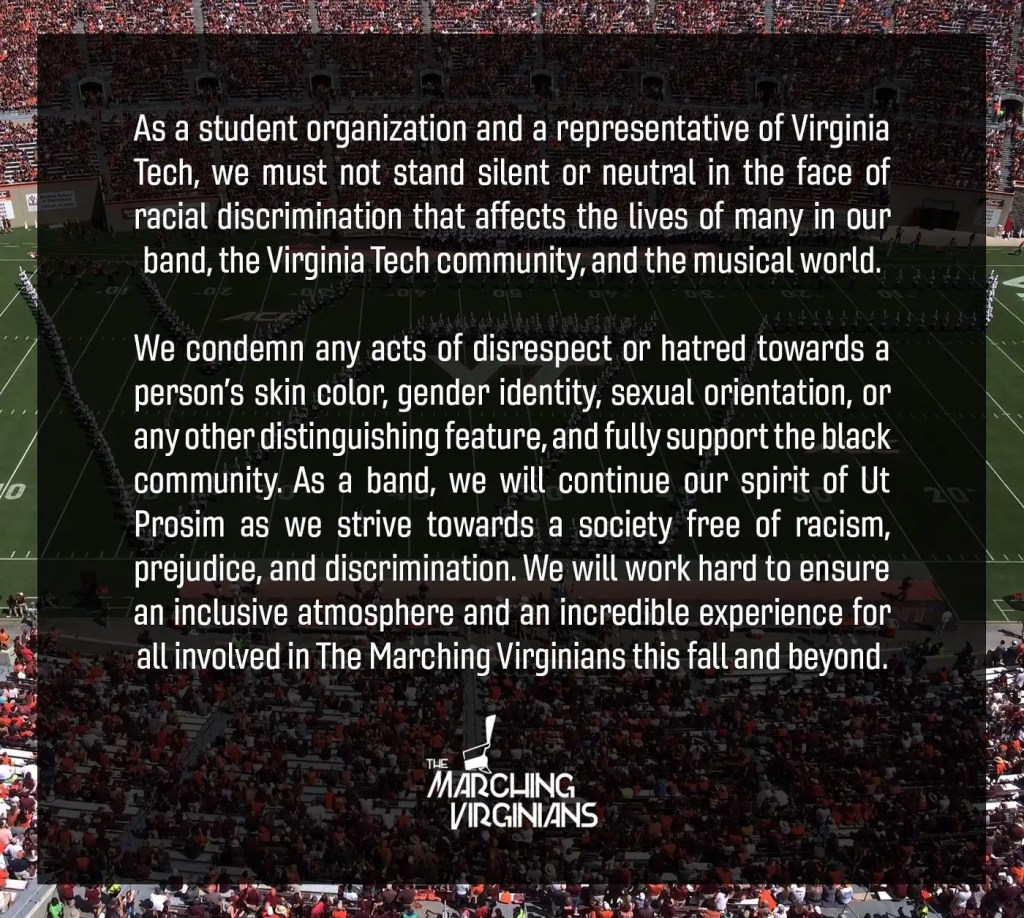
As a student organization, the Marching Virginians operates inside the school of performing arts, which itself exists in the college of liberal arts and human sciences. The original statement thus faced edits by faculty within the college before publication. The decision to remove the language “Black Lives Matter” from the statement came from outside the Marching Virginians, Small said.
By June 7, Middleton already decided the band would no longer play “Carry Me Back” during the upcoming season. Instead, the band would start playing an arrangement of “Shenandoah” beginning in 2020.
“Naturally, we thought ‘Shenandoah’ would work really well,” Middleton said. “Part of that is because we play ‘Power Closer,’ which has a setting of ‘Shenandoah’ in a faster tempo, so it was something I knew would be really recognizable and beautiful as a choral at the beginning, and it would also work really well as an up-tempo march version for the body of the piece.”
The band plays “Shenandoah” three different ways throughout the year, just as they did for “Carry Me Back.” After the Hokies force a turnover during football games, the band plays upbeat march section of the song. The band also plays an extended version of the song, which opens with a slow, legato choral before the march section, during their annual pregame field performance. During the pregame show, the band transitions near the end of the march section of “Shenandoah” into “VPI Victory March.” Lastly, the band occasionally plays the full march section of the tune following “Tech Triumph” after the Hokies score a touchdown.
Once the directors decided on “Shenandoah” to replace “Carry Me Back,” they turned to Dr. James Sochinski, the longtime arranger for the Marching Virginians and director of the band from 1978 through 1981. Sochinski also arranged “Tech Triumph,” “VPI Victory March” and many stand tunes the band plays during games.
Though the choral section of “Shenandoah” matches the usual style of the song, the Marching Virginians’ directors tasked Sochinski with manipulating the articulation and melody to fit the march section familiar to the band in “Carry Me Back.”
“Just about any tune can be adapted to be slow, fast; loud, soft; grating, relaxing,” Sochinski said. “The first thing you want to do is adjust the rhythm to make it sharp and biting rather than smooth and flowing, but that’s easy enough to do. There’s a counter melody in the horns and the woodwinds, and this counter melody is baked into a rah-rah college fight song, so there’s a strong countermelody in both ‘Carry Me Back’ and ‘Shenandoah.’ Then I jazzed up the harmony a little bit in Shenandoah.”
Dr. Sochinski completed the arrangement of “Shenandoah” in a month over the summer without many back-and-forth adjustments with the directors needed.
“It was like he was able to superimpose the melody into what the structure of ‘Carry Me Back’ was,” Reep said. “It fit perfectly.”
That structure, what arrangers refer to as writing to spec, allowed Sochinski to finish the arrangement on short notice.
“When you’re writing something fresh and new, your choices are infinite; however, when you’re writing a spec, the criteria limit you, and the decision-making becomes easier because you have these limitations,” Sochinski said. “It was not all that difficult to put ‘Shenandoah’ in exactly the same count structure of ‘Carry Me Back.’”
“Shenandoah” immediately became a hit with the students, staff and fans of the band, combining a style familiar to the band with a song familiar to those in the Commonwealth.
“I think it’s awesome,” Middleton said. “I kind of wondered: Are people going to miss ‘Carry Me Back?’ I don’t think that is [the case]. I think it is done and gone, and that’s exactly the way it should be. I think it turned out really well.”
Just as Sochinski had to arrange the song quickly, the band learned the tune, a new piece for everyone, just as fast.
“I like that it still follows the main hits that ‘Carry Me Back’ did,” Small said. “I think Dr. Sochinski did an amazing job making it fit and make sense. I don’t think about ‘Carry Me Back’ at all anymore.”
The switch from “Carry Me Back” to “Shenandoah” represents a significant change for the band; however, they could not share this achievement with their usual audience inside Lane Stadium this season. During the first football game, the full band played on the lawn of the baseball stadium with their sound pumped into Lane Stadium. Later in the season, smaller groups made up of about half the band played to a crowd limited to the players’ family and friends in Lane Stadium. The last two home games will not include the band in any capacity.
“Did we do this change, and nobody’s going to know?” Reep said. “My answer to that is we don’t make changes so that we can receive a pat on the back; we do it because it’s right. If it helps in any way, that’s what I care about.”
As a new traditional song for the band, the Marching Virginians will continue to share ‘Shenandoah’ with Hokie fans for years to come.
“This is well overdue, and it was exciting to be a part of –– it still is –– and I think it’s something that we [will] continue to promote next season if we’re back to normal,” Reep said. “I hope that this isn’t the last thing that we do in terms of making positive changes within our organization, but I’m proud of the fact that we were able to do something that we said we were going to do. What matters to me is making a positive change for the organization and that the students involved feel better about what we’re doing, feel accepted and feel it’s a safer place to be.”
Just south of the Shenandoah Valley, the small college town of Blacksburg now hosts a band set to share a new song –– for those who have passed and for those to come.
 Sam Alves